Vascular EDS
Last reviewed: 2026-06-09
Vascular Ehlers-Danlos Syndrome (vEDS) is a rare, serious connective tissue disorder caused by changes in the COL3A1 gene (or, rarely, specific COL1A1 variants) that weaken type III collagen — the protein that gives strength to blood vessels and hollow organs. People with vEDS are at risk of arterial aneurysm, dissection, and rupture, as well as rupture of the bowel or uterus. Visible signs can include thin, translucent skin, easy bruising, a characteristic facial appearance, and an aged look to the hands and feet (acrogeria). vEDS is inherited in an autosomal dominant pattern: a change in one copy of the gene is enough to cause the condition.
Genetics & Inheritance
COL3A1 or COL1A1
Caused by mutations at specific locations in ONE copy of COL3A1 or COL1A1
Signs & Features of vEDS
Arterial aneurysm or rupture
These terms describe ways an artery wall can be affected when it is unusually fragile: an aneurysm is a bulge, a dissection is a tear between the layers of the wall, and a rupture is a break through it. In vascular EDS the connective tissue in artery walls is weakened, which is why these are recognized features of the type. Understanding them is central to understanding vascular EDS.
Fragility of hollow organs
Hollow organs, such as the bowel and the uterus, have walls that contain connective tissue for strength. In vascular EDS this tissue is weakened, which can make the walls of these organs more fragile. It is one of the recognized features of this type.
Gastrointestinal rupture
Gastrointestinal rupture is a tear in the wall of the digestive tract, most often the large bowel, which can happen when that wall is fragile as in vascular EDS. It reflects the same weakness of connective tissue that affects the blood vessels in this type. It is a recognized feature that helps explain why the gut is involved.
Carotid-cavernous sinus fistula
A carotid-cavernous fistula is an abnormal connection that forms between an artery near the base of the skull and a network of veins behind the eye. It is a recognized feature of vascular EDS, arising from the fragility of the blood vessels in this type. It can affect the eye and the vessels around it.
Thin, translucent skin
In vascular EDS the skin can be unusually thin and see-through, so that the veins beneath are clearly visible, particularly over the chest and abdomen. This translucency reflects the reduced thickness and altered structure of the skin in this type. It is one of its characteristic features.
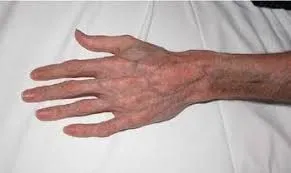
Acrogeria
Acrogeria refers to an aged appearance of the hands and feet, where the skin looks thin, and the underlying veins and tendons are unusually visible. It results from reduced fatty padding and thin skin over these areas. It is most characteristic of vascular EDS, though it is described in other rare types as well.
Hypermobility of small joints
In some rare EDS types the extra range of movement is most noticeable in the small joints, such as those of the fingers and toes, rather than the large joints. This reflects the laxity of the ligaments that normally limit how far these joints bend. It can make the small joints prone to slipping or overextending.
Organ prolapse
Prolapse is when an internal organ slips downward from its usual position because the connective tissue and muscle supporting it are weakened. It can affect organs such as the bowel, bladder, uterus, or rectum. In rare EDS types the supporting tissue is more lax, which can make prolapse more likely.
Photos are illustrative examples of individual findings; appearance varies widely from person to person. This page is educational and is not a diagnostic tool — see our disclaimer.
Sources
Brady AF, Demirdas S, Fournel-Gigleux S, Ghali N, Giunta C, Kapferer-Seebacher I, et al. The Ehlers-Danlos syndromes, rare types. Am J Med Genet C Semin Med Genet. 2017;175(1):70-115.
Malfait F, Francomano C, Byers P, Belmont J, Berglund B, Black J, et al. The 2017 international classification of the Ehlers-Danlos syndromes. Am J Med Genet C Semin Med Genet. 2017;175(1):8-26.
Angwin C, Ghali N, et al. Ehlers-Danlos syndromes, rare types: Clinical and molecular review. Eur J Hum Genet. 2023;31(2):131-142.
Living with Vascular EDS? You're not alone.
Join Our Community