Myopathic EDS
Last reviewed: 2026-06-09
Myopathic Ehlers-Danlos Syndrome (mEDS) is a rare connective tissue disorder caused by changes in the COL12A1 gene, which affects type XII collagen at the interface between muscle and connective tissue. Its hallmark is muscle weakness and/or muscle wasting (atrophy) that begins in infancy or childhood and tends to improve with age. People with mEDS typically have hypermobility of the smaller, distal joints together with soft doughy skin, atrophic scarring, and changes visible on muscle biopsy. mEDS can be inherited in either an autosomal dominant or autosomal recessive pattern, depending on the specific change in the COL12A1 gene.
Genetics & Inheritance
COL12A1
Caused by mutations at specific locations in ONE or BOTH copies of COL12A1
Signs & Features of mEDS
Muscle weakness and/or atrophy in infancy or childhood
Muscle weakness means the muscles generate less force than expected, and atrophy means they are reduced in size. In several rare EDS types these features can appear in infancy or childhood and contribute to reduced stamina and difficulty with physical tasks. They reflect the involvement of connective tissue within and around muscle.
Distal joint hypermobility
In some rare EDS types the extra range of movement is most noticeable in the small joints, such as those of the fingers and toes, rather than the large joints. This reflects the laxity of the ligaments that normally limit how far these joints bend. It can make the small joints prone to slipping or overextending.
Hyperelasticity and atrophic scarring
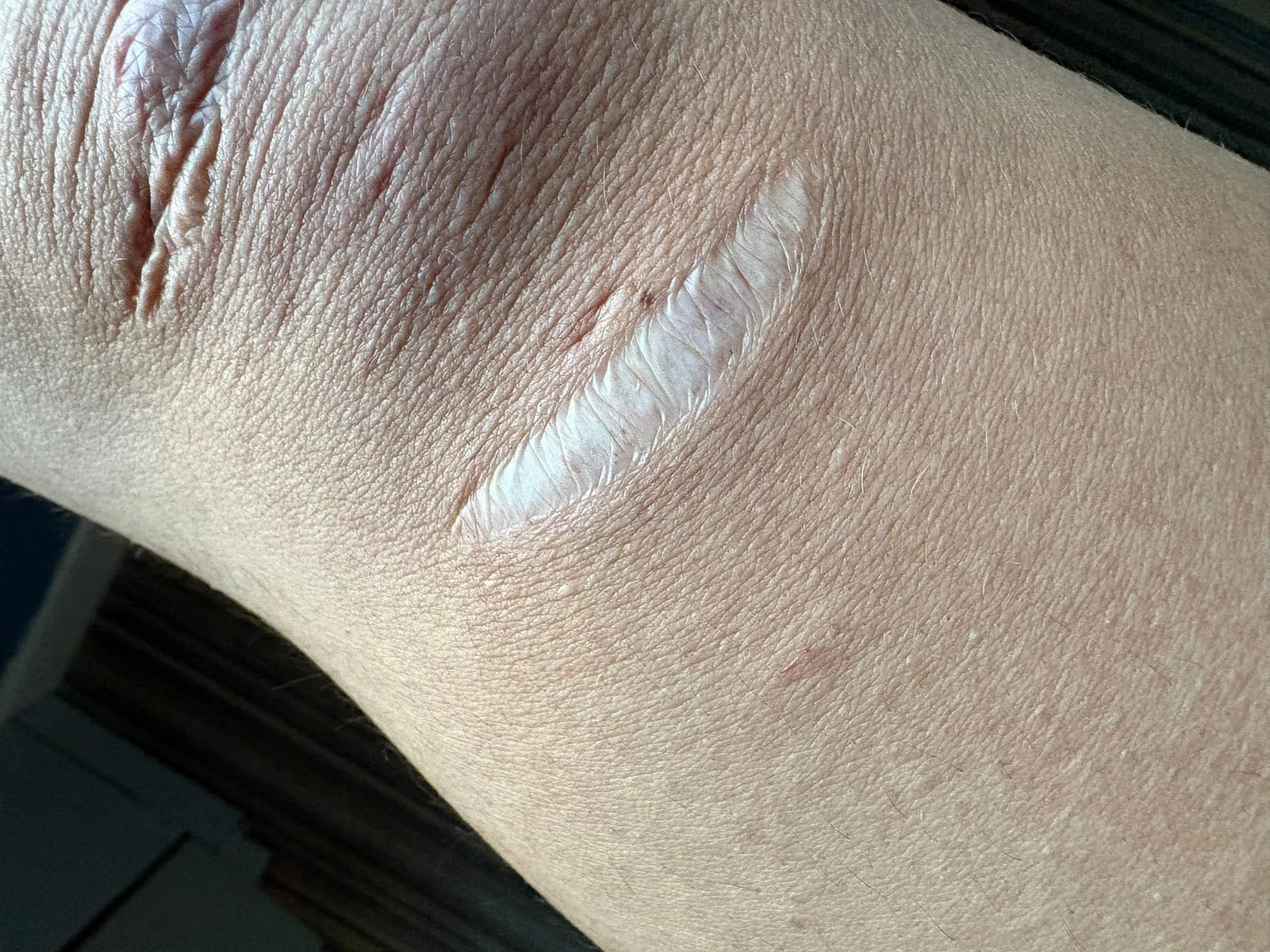
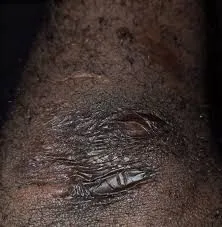
Atrophic scars are wide, thin, sunken scars that form when fragile skin heals poorly after injury. In several rare EDS types, even minor wounds can leave papery, wrinkled scars — often compared to cigarette paper — most visibly over the forehead, knees, elbows, and shins.
Soft, doughy skin
Soft, doughy skin feels unusually soft and gives way easily to the touch, a little like dough. It is described in several rare EDS types and reflects changes in the texture and support of the skin. The skin may also be stretchy or fragile alongside this softness.
Myopathy on muscle biopsy
Myopathy means a disorder of muscle tissue itself. In myopathic EDS, examining a small sample of muscle under the microscope (a biopsy) can show characteristic changes, helping to explain the muscle weakness seen in this type. These findings reflect the involvement of connective tissue within the muscle.
Photos are illustrative examples of individual findings; appearance varies widely from person to person. This page is educational and is not a diagnostic tool — see our disclaimer.
Sources
Brady AF, Demirdas S, Fournel-Gigleux S, Ghali N, Giunta C, Kapferer-Seebacher I, et al. The Ehlers-Danlos syndromes, rare types. Am J Med Genet C Semin Med Genet. 2017;175(1):70-115.
Malfait F, Francomano C, Byers P, Belmont J, Berglund B, Black J, et al. The 2017 international classification of the Ehlers-Danlos syndromes. Am J Med Genet C Semin Med Genet. 2017;175(1):8-26.
Angwin C, Ghali N, et al. Ehlers-Danlos syndromes, rare types: Clinical and molecular review. Eur J Hum Genet. 2023;31(2):131-142.
Living with Myopathic EDS? You're not alone.
Join Our Community