Dermatosparaxis EDS
Last reviewed: 2026-06-09
Dermatosparaxis Ehlers-Danlos Syndrome (dEDS) is an extremely rare connective tissue disorder caused by changes in the ADAMTS2 gene, which normally helps process collagen into its mature form. Its most striking feature is severely redundant, stretchy, loose, or lax skin, along with severe skin fragility that bruises and tears easily. People with dEDS often have characteristic craniofacial features, increased palmar wrinkling, hernias, joint hypermobility, and delayed gross motor development. dEDS is inherited in an autosomal recessive pattern, so a person must inherit a change in both copies of the ADAMTS2 gene to be affected.
Genetics & Inheritance
ADAMTS2
Caused by mutations at specific locations in BOTH copies of ADAMTS2
Signs & Features of dEDS
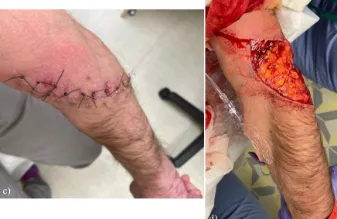
Severe redundant, stretchy, loose, or lax skin
Lax skin is loose and sagging, hanging in folds rather than fitting closely to the body, and it does not spring back quickly when stretched. In dermatosparaxis EDS this looseness can be marked and is present from early life, often with extra folds at the joints and abdomen. It reflects a profound weakness in the skin’s collagen framework.
Severe skin fragility
Fragile skin tears, splits, or breaks more easily than usual, sometimes from minor knocks or friction. In several rare EDS types the skin is mechanically weak because its supporting collagen is altered, so wounds can be larger or deeper than the injury would suggest. This fragility also makes wounds harder to close and slower to heal.
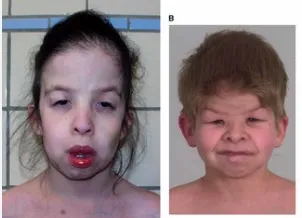
Craniofacial features
Dermatosparaxis EDS is associated with a distinctive group of facial features. These often include a large soft spot (fontanelle) on the head in infancy, puffy eyelids, skin folds at the inner corners of the eyes (epicanthal folds), downward-slanting eye openings, a blue tint to the whites of the eyes, and a small lower jaw. Together these create a characteristic appearance that varies between individuals.
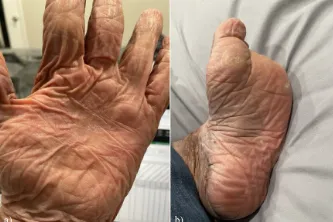
Increased palmar or plantar wrinkling
This refers to extra creases and wrinkles in the skin of the palms and soles, beyond the usual lines. It reflects the loose, redundant skin seen in dermatosparaxis EDS. The wrinkling can be noticeable from early life.
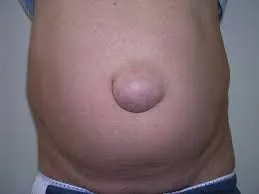
Umbilical hernia or hernia(s)
A hernia is a bulge that forms when an internal organ or tissue pushes through a weak spot in the muscle or connective tissue wall meant to contain it. Common sites include the navel (umbilical) and groin. In rare EDS types the supporting tissue is weaker than usual, so hernias can form more readily and sometimes recur.
Joint hypermobility
Joints that move well beyond the normal range, affecting many joints throughout the body rather than just one or two. In the rare EDS types this is present from birth and is often severe, contributing to joint instability, pain, and frequent sprains.
Gross motor delay
Motor delay means reaching physical milestones such as sitting, crawling, or walking later than usual. In the rare EDS types it often reflects a combination of low muscle tone and very loose joints, which make stable, coordinated movement harder to achieve. The pattern and degree of delay differ from child to child.
Ocular fragility
Ocular fragility means the outer tissues of the eye, including the white sclera, are weaker and more easily injured than usual. This reflects the altered connective tissue that gives the eye its structure in certain rare EDS types. It is part of the broader tissue fragility seen in these conditions.
Cardiovascular fragility
Vascular fragility means that blood vessels are weaker than usual because the connective tissue in their walls is altered. This can make them more prone to bruising, bleeding, or injury. It is a feature reported in several rare EDS types and varies in degree.
Photos are illustrative examples of individual findings; appearance varies widely from person to person. This page is educational and is not a diagnostic tool — see our disclaimer.
Sources
Brady AF, Demirdas S, Fournel-Gigleux S, Ghali N, Giunta C, Kapferer-Seebacher I, et al. The Ehlers-Danlos syndromes, rare types. Am J Med Genet C Semin Med Genet. 2017;175(1):70-115.
Malfait F, Francomano C, Byers P, Belmont J, Berglund B, Black J, et al. The 2017 international classification of the Ehlers-Danlos syndromes. Am J Med Genet C Semin Med Genet. 2017;175(1):8-26.
Angwin C, Ghali N, et al. Ehlers-Danlos syndromes, rare types: Clinical and molecular review. Eur J Hum Genet. 2023;31(2):131-142.
Living with Dermatosparaxis EDS? You're not alone.
Join Our Community